Run CI on exe.dev, a fresh VM for every job
A warm base VM, a fresh copy per job, deleted when the job ends.
CI needs two things that usually pull against each other: a clean machine for every job, and a machine that already has your toolchain, your dependencies, and your build cache. Hosted CI gives you the first and makes you pay for the second in setup minutes on every run. On exe.dev you get both: keep one base VM warm, and for every job copy it into a fresh sandbox that is deleted when the job ends.
This page explains that pattern, builds a complete CI with it in one short script (a push webhook in, a commit status out, for GitHub, Forgejo, Gitea, or Codeberg), and points to the pages for GitHub Actions, GitLab, Buildkite, and the rest, which use the same pattern with each service's own runner.
What you get#
- A base VM with your toolchains and warm caches, ready to be copied
- The ci-dispatcher service, which tests every push in a fresh sandbox and deletes it afterwards
- The exe.dev API key and the forge token held by integrations, on no VM
- A commit status on every push, linking to the job's log
What's running, and where
https://my-ci.exe.xyz/
signed push webhooks and one-time source downloads, nothing else
https://my-ci.exe.xyz:8080/
the job logs, linked from each commit status
ssh my-ci-base.exe.xyz
the base VM, to install toolchains and warm caches
How CI works on exe.dev#
- A warm base VM. An ordinary VM that never runs a job. You install your toolchains on it and build your project there once, so its disk holds the module cache, the build cache, and the Docker images.
- A fresh copy per job.
ssh exe.dev cp my-ci-base --sandboxmakes a new VM with a copy of that disk in under a second (0.5 to 0.7 seconds in our tests). The job starts with everything installed and every cache warm, and nothing it writes goes back to the base. - Deleted afterwards. When the job ends,
rmdeletes the copy, its disk, and whatever the job left on it. - A dispatcher. A small always-on program on a third VM that hears about jobs (from a webhook, or by asking your CI service) and makes and deletes the copies. Each CI service's runner page has one; this page has a generic one.
What that gets you:
- Real CPUs. A sandbox's vCPUs and memory are reserved for it, not
shared with your other VMs or with other jobs, and it's a whole VM: its
own kernel,
sudo, and Docker without tricks, on a normal Ubuntu machine. - No leftover state. Every job starts from the same disk. A job can't see the last one's files, processes, or credentials, and can't poison the next one's cache.
- Pay only while jobs run. Sandboxes are billed by the second, from the copy to the delete, at $0.105 an hour per 2 vCPU / 4 GiB. Nothing is billed for job VMs between jobs, because there aren't any.
- No keys on any VM. The dispatcher reaches exe.dev's API and your forge through integrations: exe.dev holds the tokens and adds them to requests at the network edge. A job VM holds nothing but the job.
Pick your CI#
If you already use a CI service, keep its workflows and move only where the jobs run. Each page sets up the same pattern with that service's own runner. Without one, or with a forge that has no runner you like, use the recipe below.
 GitHub ActionsJust-in-time runnersChange
runs-on to [self-hosted, exe]; each job gets a fresh copy of the base, registered for that one job.Run GitHub Actions jobs on exe.dev →
 GitLab CI/CDGitLab RunnerA GitLab Runner that runs each job on a fresh sandbox, for gitlab.com and self-managed GitLab.Run GitLab CI jobs on exe.dev →
 BuildkiteBuildkite agentsOne agent per job on a fresh sandbox, with queues for sizes and the agent token in an integration.Run Buildkite agents on exe.dev →
 Forgejo, Gitea, CodebergThis pageThey send the same push webhooks and take the same commit statuses as GitHub, so the recipe below works with them as is.A CI in one script →
 TangledSpindlesHost your repositories on your own knot, and run Tangled's CI on a spindle of your own.Host your Tangled repos →
✓Anything elseThis pageA webhook in, a script from the commit on a fresh sandbox, a commit status out. One Python file, no CI service.A CI in one script →
To host the forge itself on exe.dev, see Forgejo and Gitea; the recipe below reaches a private one through a VM-to-VM integration.
Two more pages speed up builds whichever CI runs them. Point jobs, and laptops, at a shared builder whose cache stays warm between runs:
docker buildx build from CI and laptops.Run a remote Docker builder →
❄Nix builderRemote builder and cacheA Nix remote builder that also serves a signed binary cache, private behind exe.dev login.Run a Nix remote builder →
A CI in one script#
This is the whole pattern without a CI service. On every push to your repository:
- the forge sends a signed webhook to
ci-dispatcher.py on
my-ci, which posts a pending commit status; - the dispatcher downloads the commit's source through the forge's API,
copies
my-ci-baseinto a new sandbox, and runs the commit's ownci.shthere, streaming the output into a log; - it posts success or failure, linking to the log, and deletes the sandbox.
GitHub, Forgejo, Gitea, and Codeberg sign push webhooks the same way and share one commit status API, so the same script works with all four. The job VM never sees a token: it fetches the source from the dispatcher through a one-time URL.
20:20:24 20261104-202024-5a55: queued you/app refs/heads/main 106dd5b
20:20:27 20261104-202024-5a55: started my-ci-job-20261104-202024-5a55 for you/app 106dd5b
20:20:34 20261104-202024-5a55: success: passed in 8s; deleted my-ci-job-20261104-202024-5a55
That push, to a small Go project whose ci.sh runs go vet, go test -race, and a Docker container, went from webhook to green check in 10
seconds. Copying the base took 0.7 of them. The same ci.sh took 22
seconds on a fresh VM without the warm caches.
Before you start#
- An exe.dev account that can create sandboxes. Personal accounts can. On
a Work team, an admin turns them on with
ssh exe.dev team settings standalone all-users. - A repository on GitHub, Forgejo, Gitea, or Codeberg, and the right to
add webhooks to it. The steps use
you/app; put yours in its place.
Prepare the base VM#
On your computer, create the base. The ci tag matters: the dispatcher's
exe.dev key will only be able to touch VMs with it.
ssh exe.dev new --name=my-ci-base --tag=ci
VM names are global, so pick any free name, and use it for BASE_VM
later. The base starts with what the default exe.dev image ships: Docker,
Go, Python with uv, git, and build tools. Install whatever else your
build needs, and start Docker at boot so every copy has it running:
ssh my-ci-base.exe.xyz 'sudo systemctl enable --now docker.service'
ssh my-ci-base.exe.xyz 'sudo apt-get install -y postgresql-client'   # for example
Then warm the caches by building your project there once. Jobs run as the
same exedev user, so they find ~/go/pkg/mod, ~/.cache/go-build,
~/.npm, ~/.cache/pip, or ~/.cargo already full. From a checkout on
your computer:
rsync -a --exclude=.git ./ my-ci-base.exe.xyz:warm/
ssh my-ci-base.exe.xyz 'cd warm && bash ci.sh; cd && rm -rf warm && sync'
End with sync: copies get what's on the base's disk. Don't put secrets
on the base; everything on it is on every job's VM.
Create the dispatcher and its keys#
On your computer:
ssh exe.dev new --name=my-ci
exe.dev. Make an API key that can copy, list, reach, and delete VMs
tagged ci, and nothing else, and hand it to an
HTTP proxy integration that only my-ci
can use:
ssh exe.dev ssh-key generate-api-key --label=ci-dispatcher --tag=ci \
    --cmds=cp,ls,rm,ssh --exp=1y --json | jq -r .token \
  | ssh exe.dev integrations add http-proxy --name ci-exe \
    --target https://exe.dev --bearer - --attach vm:my-ci
Copies of the base carry its ci tag, so the key can delete them too.
The forge. The dispatcher reads the source of the pushed commit and writes commit statuses, so it needs a token that can do both, for the repositories you're testing and nothing else:
- GitHub: a fine-grained personal access token with access to only those repositories, and the repository permissions Contents: Read-only and Commit statuses: Read and write.
- Forgejo, Gitea, Codeberg: an access token from Settings → Applications with the repository: Read and write scope. These tokens apply to every repository you can write to, so on a forge you share, make a separate user for CI and give it write access to only the repositories it tests.
Put the token in a second integration, with the forge's address as the
target (https://api.github.com, https://codeberg.org, or your own
forge's URL). This reads it without echoing it or saving it in your shell
history:
printf 'Forge token: '; read -rs T; echo
printf %s "$T" | ssh exe.dev integrations add http-proxy --name ci-forge \
  --target https://api.github.com --bearer - --attach vm:my-ci
unset T
For a forge on an exe.dev VM, which exe.dev's login keeps private, make it
a VM-to-VM integration instead: add
--peer and use the VM's address, --target https://my-forgejo.exe.xyz/.
exe.dev then lets my-ci through the login (a plain proxy gets 401),
and the token signs it in to Forgejo.
Warning
Attach both integrations to
my-cionly (--attach vm:my-ci), never by thecitag: every job VM carries that tag, and any pushedci.shcould then create VMs or write to your repositories.
Check both from the dispatcher VM (ssh my-ci.exe.xyz):
curl -s -X POST https://ci-exe.int.exe.xyz/exec -d ls | jq -r '.vms[].vm_name'
curl -s https://ci-forge.int.exe.xyz/repos/you/app | jq .full_name
The first prints my-ci-base and nothing that isn't tagged ci. The
second prints "you/app"; on Forgejo, Gitea, and Codeberg, whose API
lives under /api/v1, ask
https://ci-forge.int.exe.xyz/api/v1/repos/you/app instead.
Start the dispatcher#
On the VM (ssh my-ci.exe.xyz), fetch the dispatcher and write its
settings, with a fresh secret for the webhooks:
mkdir -p ~/ci
curl -fsSL -o ~/ci/ci-dispatcher.py https://exe-staging.dev/deploy/ci/ci-dispatcher.py
(umask 077; cat > ~/ci/env <<EOF
EXE_API=https://ci-exe.int.exe.xyz
FORGE_API=https://ci-forge.int.exe.xyz
FORGE=github
REPOS=you/app
BASE_VM=my-ci-base
CP_FLAGS="--cpu=2 --memory=4GB"
MAX_JOBS=4
WEBHOOK_SECRET=$(openssl rand -hex 32)
EOF
)
FORGE_API,FORGE: for Forgejo, Gitea, or Codeberg, useFORGE_API=https://ci-forge.int.exe.xyz/api/v1andFORGE=forgejo.REPOS: the repositories to test,owner/name, separated by spaces. Pushes to any other repository are ignored.CP_FLAGS: each job VM's size. Leave--cpuand--memoryin: a copy otherwise takes the base's memory, which may be more than the 2 GiB per vCPU a sandbox is billed for.MAX_JOBS: at most this many job VMs at once; later pushes wait their turn. Keep it under your plan's VM limit (50 on Personal) minus the VMs you already have.- Optional:
CI_SCRIPT(ci.sh), the script each commit runs;MAX_MINUTES(60), after which a job fails;CONTEXT(exe.dev), the name its status has on the forge.
Run it as a service, so it comes back after a crash or a reboot:
sudo tee /etc/systemd/system/ci-dispatcher.service >/dev/null <<'EOF'
[Unit]
Description=CI on exe.dev sandboxes
After=network-online.target
Wants=network-online.target

[Service]
User=exedev
EnvironmentFile=/home/exedev/ci/env
ExecStart=/usr/bin/python3 /home/exedev/ci/ci-dispatcher.py
Restart=always
RestartSec=5

[Install]
WantedBy=multi-user.target
EOF
sudo systemctl daemon-reload
sudo systemctl enable --now ci-dispatcher
journalctl -u ci-dispatcher -n 5 --no-pager -o cat
The log ends with testing pushes to you/app on copies of my-ci-base.
The forge must reach port 8000, so make it public. On your computer:
ssh exe.dev share set-public my-ci
Only requests signed with the webhook secret do anything there; anything
else gets 401. The job logs on port 8080 stay private: the
HTTPS proxy never makes ports other than 8000 public.
Add the webhook#
Show the secret on the VM with grep WEBHOOK_SECRET ~/ci/env. Then, in
the repository's settings:
- GitHub: Settings → Webhooks → Add webhook. Payload URL
https://my-ci.exe.xyz/, content typeapplication/json, the secret, and Just the push event. - Forgejo, Gitea, Codeberg: Settings → Webhooks → Add webhook →
Forgejo (or Gitea). Target URL
https://my-ci.exe.xyz/, POST,application/json, the secret, and Push events.
GitHub's first delivery, a ping, is answered with 204. On Forgejo and
Gitea, Test delivery sends a push for the latest commit, which runs a
real job.
Add ci.sh and push#
ci.sh is the job: a script at the top of your repository that runs from
a fresh copy of the commit, in ~/src on the job VM, and passes or fails
by its exit code. For a Go project:
#!/usr/bin/env bash
set -euo pipefail
go vet ./...
go test -race ./...
docker build -t app .
It can run anything the base has: npm ci && npm test, uv run pytest,
cargo test, docker compose up -d for a test database. CI=true,
CI_REPO, CI_REF, and CI_SHA are set. The source comes as the
forge's archive of the commit, without .git; a script that needs git
history can git clone a public repository instead.
Commit it, push, and watch the dispatcher on my-ci:
journalctl -u ci-dispatcher -f -o cat
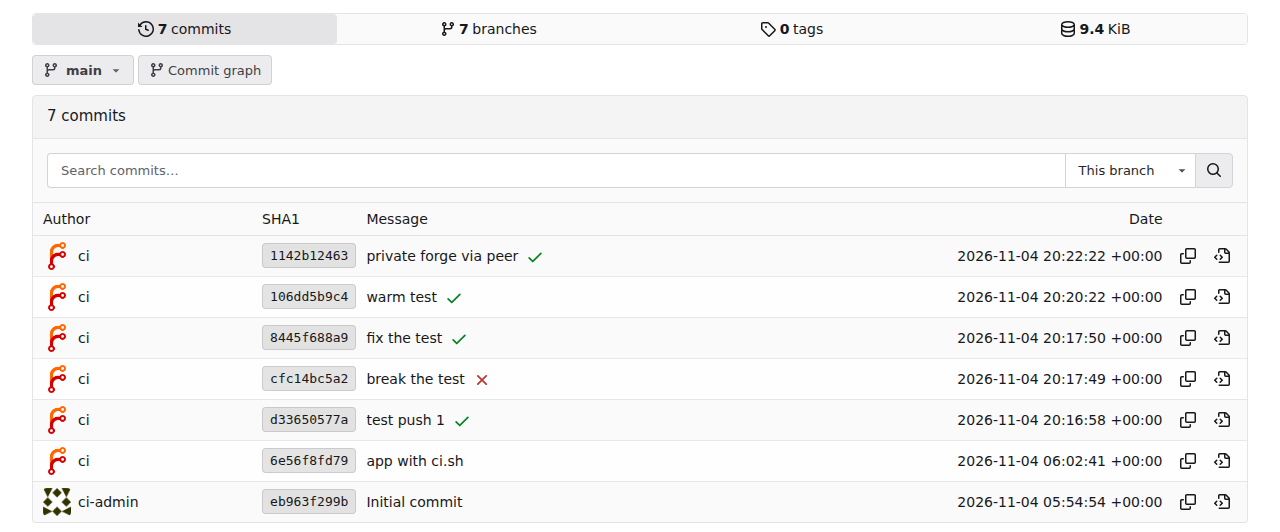
The commit shows a yellow pending mark at once and a green check (or a red cross) when the job ends:
To require a passing job before merging, add the exe.dev status check
to the branch's protection rule (Settings → Branches on GitHub,
Forgejo, and Gitea).
Keep it running#
- Refresh the base when dependencies change a lot, or weekly: rerun the
warm-up and
sync. Jobs already running keep their copy. - Update the dispatcher by fetching
ci-dispatcher.pyagain andsudo systemctl restart ci-dispatcher. Jobs it was running are deleted and run again from the start. - Rotate the keys: the exe.dev key above expires in a year, the forge
token when you chose. Make a new one,
ssh exe.dev integrations remove ci-exe(orci-forge), and add it again as above. - Old logs stay in
~/ci/logs; delete what you don't need, for example from cron withfind ~/ci/logs -mtime +30 -delete.
What it costs#
exe.dev bills sandboxes by the second, from the copy to the delete: $0.105 an hour per 2 vCPU / 4 GiB, so $0.00175 a minute for the default size, $0.0035 for 4 vCPU, $0.007 for 8. Each job VM lives a few seconds longer than its job; the examples add 10 seconds. The dispatcher and the base are ordinary VMs that share your plan's capacity with your other VMs and cost nothing extra (on Personal, plans start at $15 a month).
Hosted CI, for comparison: GitHub's runners are $0.006 a minute for 2 cores, $0.012 for 4, and $0.022 for 8, with every job rounded up to a whole minute. GitLab's hosted runners use compute minutes, $10 per 1,000 (extra minutes), at 1× for its small 2 vCPU runner, 2× for medium (4 vCPU), and 3× for large (8 vCPU), counted by the second.
Some months, on 30 days, before any included minutes:
| Job mix | GitHub-hosted | GitLab-hosted | exe.dev sandboxes |
|---|---|---|---|
| A small team: 50 jobs a day, 4 minutes, 2 vCPU | $36 | $60 | $10.94 |
| Many short jobs: 1,000 a day, 30 seconds, 2 vCPU | $180 | $150 | $35 |
| A busy monorepo: 300 jobs a day, 8 minutes, 4 vCPU | $864 | $1,440 | $257.25 |
| Nightly builds: 1 a day, 60 minutes, 8 vCPU | $39.60 | $54 | $12.63 |
How those are worked out, for the small team: 1,500 jobs × 4 minutes = 6,000 minutes; GitHub $0.006 × 6,000 = $36; GitLab $0.01 × 6,000 = $60; exe.dev 1,500 × 4⅙ minutes = 104.2 hours × $0.105 = $10.94. Short jobs show GitHub's rounding: 30,000 jobs of 30 seconds are billed as 30,000 minutes.
Where hosted CI stays the better deal:
- Included minutes. GitHub's Free, Pro, and Team plans include $12 to $18 of minutes a month for private repositories, and GitLab's Free and Premium 400 and 10,000 compute minutes. The small team above fits in GitLab Premium's.
- Public repositories, which run free on GitHub's standard runners.
- macOS, Windows, and arm64, which exe.dev doesn't run.
- Memory-hungry 2-core jobs. GitHub's and GitLab's 2-core runners have 8 GB; a 2 vCPU sandbox has 4 GiB, so a job that needs more takes 4 vCPU here, at twice the price.
In time, a warm base usually wins back more than it costs to start a VM:
no toolchain download, no cache restore, no docker pull.
Security#
- A fresh VM per job. Each job runs on a copy made for it and deleted after it: nothing it installs, starts, or leaves behind reaches the next job, and nothing it writes reaches the base. Jobs run side by side on separate VMs with their own kernels, not containers on a shared host.
- Keys in integrations, on no VM. The exe.dev key and the forge token
live in exe.dev's integrations, attached to
my-cialone. The key can touch only VMs taggedci, and only withcp,ls,rm, andssh. A job VM gets the source through a random one-time URL that works once and is gone when the job ends. - Signed webhooks. The dispatcher acts only on webhooks signed with
its secret, and only for repositories in
REPOS. - Pull requests from forks. This recipe tests pushes, and only people
with write access can push, so a stranger's code never runs on your VMs.
CI services that test fork pull requests on your runners run that
stranger's code at your cost: GitHub Actions
shows how to require approval and keep them on hosted runners. A
throwaway VM with no keys limits the damage, but the job can still use
the internet, your compute, and any integration attached by the
citag. - Secrets for jobs. A job that needs a credential (a package registry,
a test API, an LLM) can use an integration
attached by the
citag, so no key is on the VM. Every job can use it, including any code anyone pushes, so attach only what every job may use. - Logs. The logs are private to you and the people you
share
my-ciwith. Don't print secrets inci.sh. - A ceiling on the bill.
MAX_JOBScaps how many job VMs run at once, andMAX_MINUTEShow long each may take.
Troubleshooting#
Start with the dispatcher's log on my-ci:
journalctl -u ci-dispatcher -n 50 --no-pager -o cat.
- Nothing happens on a push. The webhook's recent deliveries on the
forge show why:
401is a secret that doesn't match~/ci/env; a redirect to a login page meansmy-ciisn't public. A204with noqueuedline means the repository isn't inREPOS. status pending: HTTP Error 403or404. The forge token lacks a permission on that repository, orFORGE_APIlacks/api/v1on Forgejo, Gitea, or Codeberg.CI error: HTTP Error 401. The exe.dev key inci-exeis wrong, expired, or revoked.CI error: HTTP Error 422. exe.dev refused the copy: sandboxes aren't enabled for your team, the VM limit is reached, orBASE_VMisn't taggedci.ssh exe.dev cp my-ci-base --sandboxon your computer shows the reason; delete that copy afterwards.no ci.sh in this commit. The commit has noci.shat the top of the repository (or noCI_SCRIPT).- A job can't find a tool or a cached package. It wasn't on the base's
disk when the job's VM was copied. Install it,
sync, and push again. - Leftover job VMs. The dispatcher deletes them, and deletes any left
from before when it starts. To see them yourself:
ssh exe.dev ls --json | jq -r '.vms[].vm_name | select(startswith("my-ci-job-"))'.
Frequently asked questions#
How do I run CI on exe.dev?
Keep one VM with your toolchains and caches as a base, copy it into a fresh sandbox for each job with cp --sandbox, run the job, and delete the copy. Your CI service's runner does that for you on GitHub Actions, GitLab, and Buildkite; for anything else, the recipe on this page does it with a webhook and the commit status API.
How much does CI on exe.dev cost?
A 2 vCPU / 4 GiB sandbox is $0.105 an hour, billed by the second from copy to delete: about $0.00175 a minute, against $0.006 for GitHub's 2-core runner and $0.01 for GitLab's small one. The dispatcher and the base are ordinary VMs on your plan. See What it costs for whole months, and when hosted minutes stay cheaper.
Why a VM per job instead of a container?
A sandbox is a whole machine: its own kernel, sudo, Docker that works without tricks, and vCPUs reserved for it, so jobs don't slow each other down. Nothing a job does survives it, and copying a warm base took under a second in our tests, so it costs no more time than starting a container.
Is it safe to run pull requests from forks?
The recipe here only tests pushes, which need write access to the repository, so code from forks never runs. If you do run it, each job is a throwaway VM with no keys on it, which limits what it can reach; see Security for what's left.
Where do the job logs go?
To ~/ci/logs on the dispatcher, served at https://my-ci.exe.xyz:8080/, which only you and the people you share the VM with can open. Each commit status links to its job's log.
Can jobs run on arm64, macOS, or Windows?
No. exe.dev VMs are x86-64 Linux. Keep those jobs on your CI service's hosted runners; most services let one pipeline mix both.
Do I need a sandbox per job for a small project?
No. One VM running your CI's runner all the time is simpler, and fine for your own pushes; see Just one runner. Jobs then share the VM and see what earlier ones left behind.
Updated Nov 4, 2026 · tested end to end Nov 4, 2026 · Markdown · manifest.json · Something wrong? Tell us